

Pilley’s Island Project
Overview
The Pilley’s Island Project hosts high-grade VMS mineralization with a rich mining history and strong exploration potential
-
Location
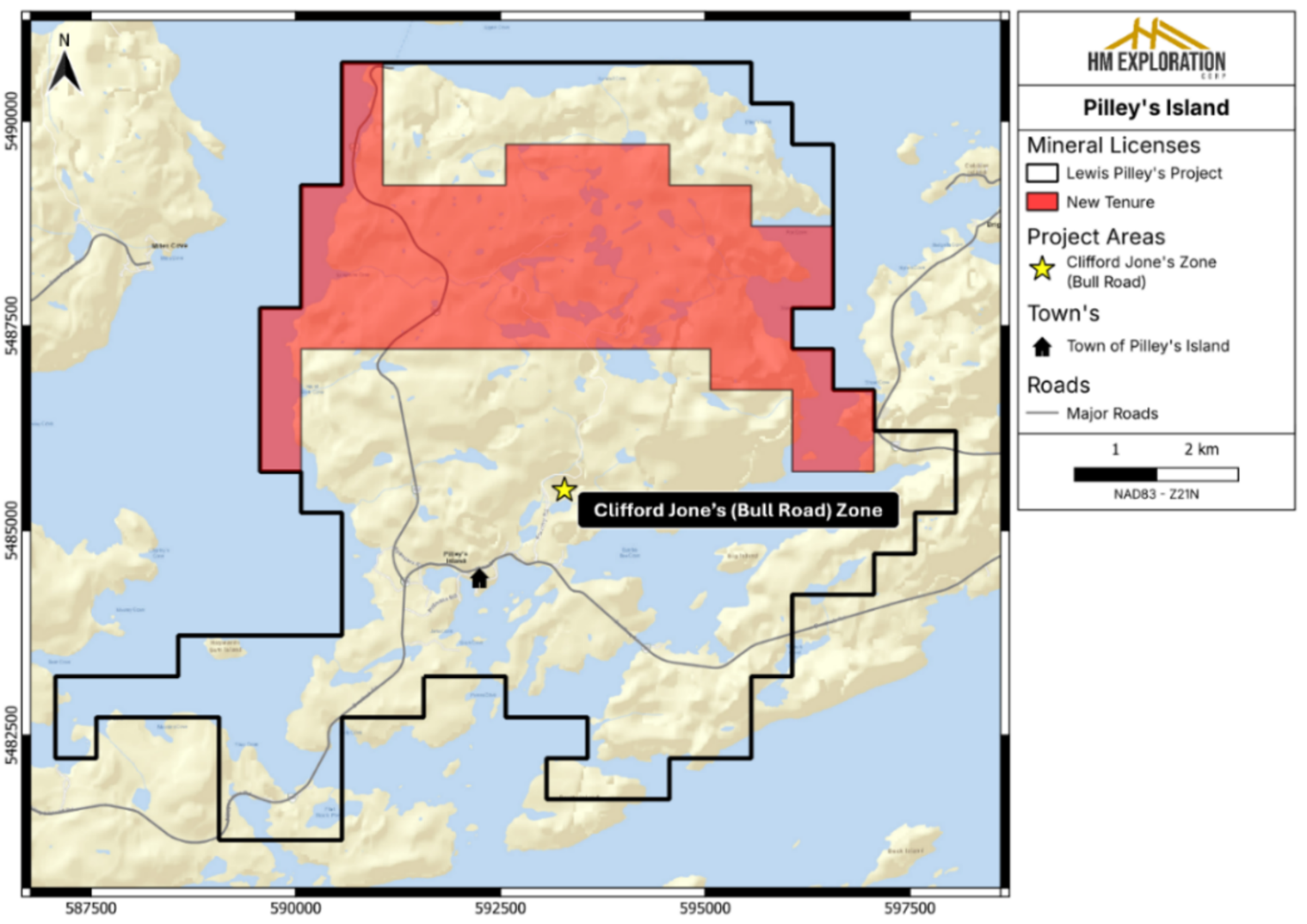
Encompasses a total land area of 60.25km2 and is located in Notre Dame Bay, Newfoundland - Canada.
-
Accessibility
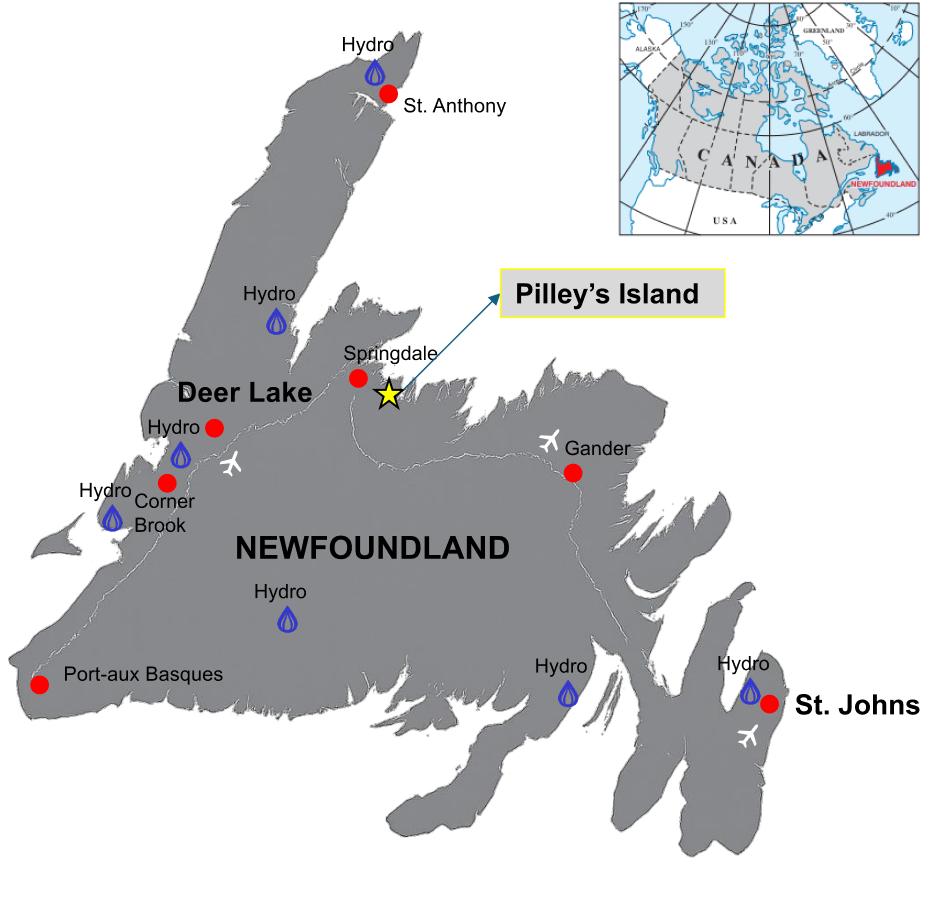
Located about 25 km east of Springdale, 210 km from Gander, and 150 km from the Pine Cove Mill and Port. The Project benefits from excellent road accessibility and proximity to key infrastructure.
-
History
It has a long-established mining history dating to the late 1800s, with about 450,000 tonnes of ore produced by the Pilley’s Island Pyrite Company Ltd., demonstrating significant mineral potential.
-
Volcanogenic Massive Sulfide
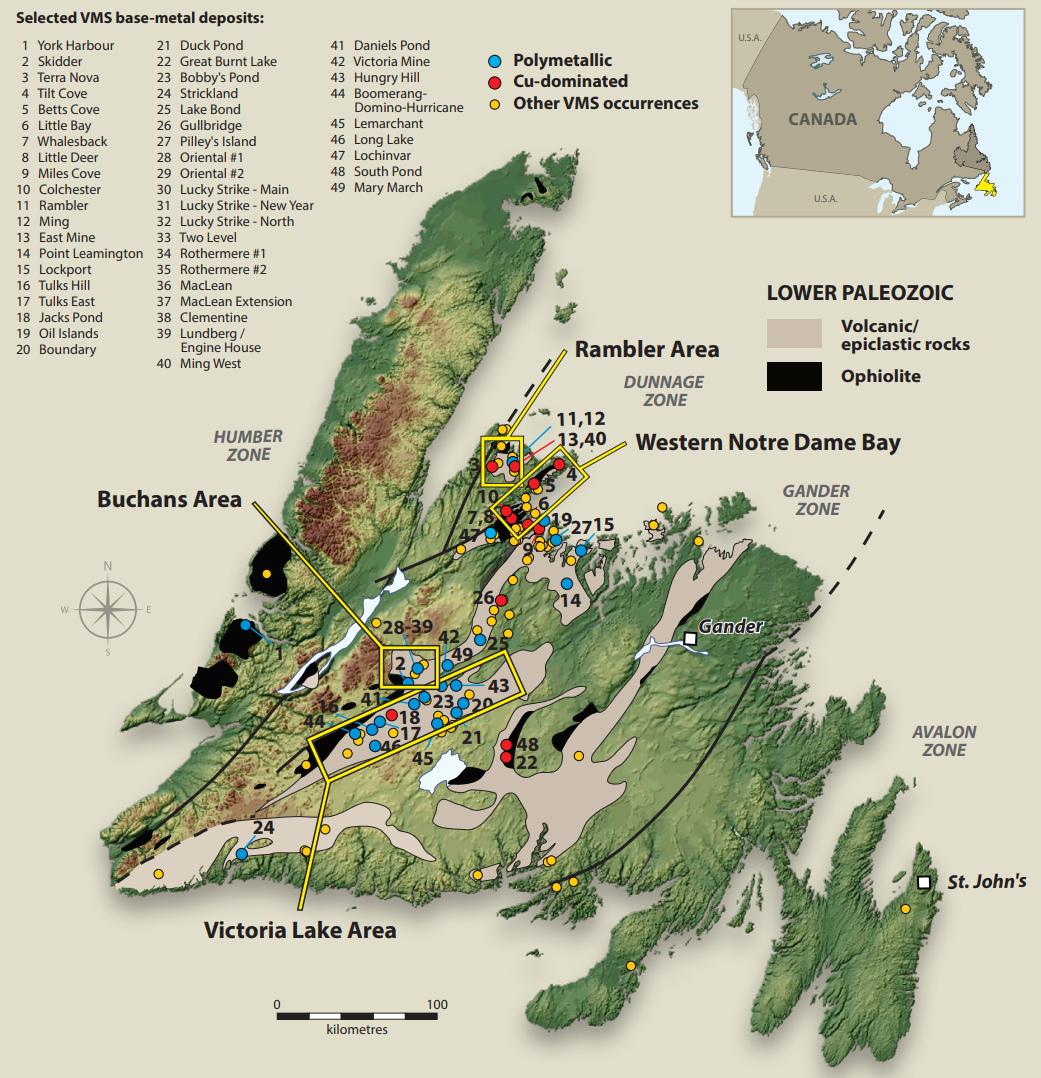
Hosts several Volcanogenic Massive Sulfide (VMS) systems with high-grade zinc, lead, copper, and silver mineralization. Its geological features resemble those of the Buchans camp, indicating strong potential for additional massive sulfide lenses.
Geology and Mineralization
Geology
- Pilley’s Island is located within the Notre Dame Subzone of the Dunnage Tectonostratigraphic Zone
- Most of the Project is underlain by Ordovician submarine volcanic rocks of the Roberts Arm Group which is regionally identified as part of a mature arc sequence referred to as the Buchans-Roberts Arm Belt that also hosts the historic Buchan’s mine.
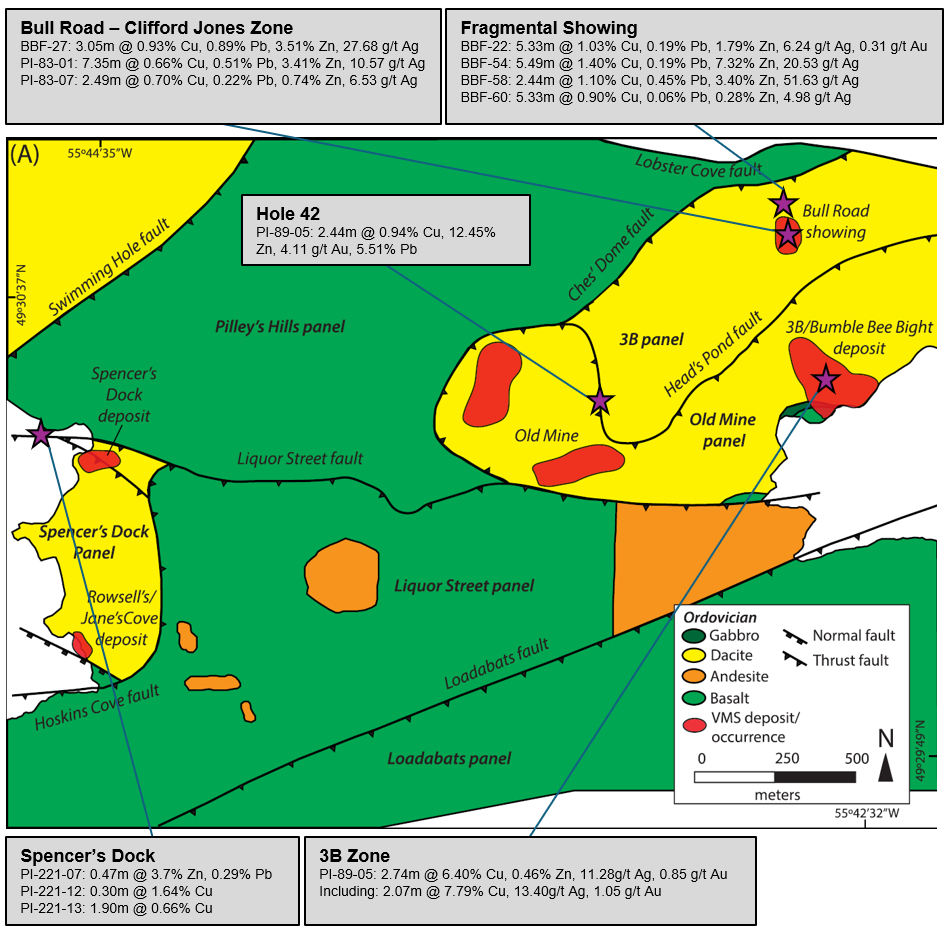
- Mineralization occurs as low grade (Spencer’s Dock); medium grade (Old Mines); and high grade (3B-Zone/Clifford Jones).
- The deposits that are of both sub-seafloor replacement and exhalative varieties. The deposits are often flanked by extensive chlorite, sericite, silica, K-feldspar and epidote alteration often observed in bimodal-felsic VMS systems.
The Spencer’s Dock area displays sericite/silica alteration that generally increases in intensity near mineralized zones, while the 3B / Old Mine areas display sericite/silica alteration that is abundant but less widespread and is more intense when proximal to mineralized zones.
Mineralization
From north to south this Project is underlain by:
-
Lushes Bight Group – Lower Ordovician
Composed of pillow basalts, pillow breccias, aquagene tuffs, massive basalt flows, flow breccias, and chlorite schist.
-
Springdale Group – Silurian
Terrestrial sequence of volcanics, pyroclastics, epiclastic to volcaniclastic sediments.
-
Roberts Arm Group – Middle Ordovician
The Roberts Arm Group, which hosts known mineralization, is complexly faulted and consist of an older tholeiitic terrane overlain by more calc- alkaline thrust slices. It is suggested that it represents an evolution from tholeiitic, back arc basalts to calc-alkaline intermediate to felsic volcanics deposited at about the time of continental collision in a neritic to littoral environment.
Newfoundland, a World-Class Jurisdiction
Tier-1 Mining Jurisdiction
- Established mining ecosystem with strong government support
- Mining sector contributes ~32% to GDP
- Readily available, skilled labor force
- Friendly and transparent mine permitting
- Rated top 6 globally in 2024 by Fraser Institute
- Hydro power abundant throughout Newfoundland
Pilley’s Island
- Project is accessible 365 days a year by road, air and sea
- ~45min drive from Springdale via Hwy 380N
- Excellent infrastructure, hosts past producing mines
- ~150km from Pine Cove Mill and Port by way of major roads
Why VMS (Volcanogenic Massive Sulphide)?
VMS Deposits are Polymetallic, High-grade and Understood Geologically
Polymetallic Revenue Streams
• Copper, zinc, lead, gold, silver (± cobalt) in a single asset
• Diversified exposures reduces reliance on a single commodity and provides a natural hedge against price volatility
High Grades & Strong Economics
• VMS deposits are known for compact footprints with robust grades in copper/zinc
• By-products (gold/silver) lower effective cash costs
Geological Predictability & Camp Scale
• Well-understood geological model; exploration is de-risked
• VMS deposits occur in clusters - one discovery often leads to several
Strategic Alignment
• Supplies critical metals for electrification (copper, zinc, cobalt)
• Governments and majors increasingly prioritizing securing supply, VMS systems are
a priority given multiple commodities present
M&A & Exit Potential
• Juniors advance discoveries, natural acquisition targets for mid-tiers/majors
• Track record of premium takeouts in established VMS camps (Noranda, Kidd Creek, Flin Flon, Iberian Pyrite Belt)